

What Is The Old Stone Age Belief That Spirits And Forces Reside In Animals
Animism (from Latin: anima , 'breath, spirit, life')[1] [2] is the belief that objects, places, and creatures all possess a distinct spiritual essence.[3] [four] [5] [half-dozen] Potentially, animism perceives all things—animals, plants, rocks, rivers, weather systems, human handiwork, and perhaps even words—as animated and alive. Animism is used in the anthropology of religion, every bit a term for the conventionalities system of many Indigenous peoples,[7] especially in dissimilarity to the relatively more than contempo development of organised religions.[8] Animism focuses on the metaphysical universe, with specific focus on the concept of the immaterial soul.[9]
Although each civilisation has their ain mythologies and rituals, animism is said to describe the virtually common, foundational thread of ethnic peoples' "spiritual" or "supernatural" perspectives. The animistic perspective is so widely held and inherent to most indigenous peoples, that they oftentimes practise not fifty-fifty accept a word in their languages that corresponds to "animism" (or even "religion");[10] the term is an anthropological construct.
Largely due to such ethnolinguistic and cultural discrepancies, opinions differ on whether animism refers to an ancestral manner of feel common to indigenous peoples around the world, or to a full-fledged faith in its own right. The currently accepted definition of animism was only developed in the late 19th century (1871) by Sir Edward Tylor. Information technology is "ane of anthropology's earliest concepts, if not the first".[11]
Animism encompasses the beliefs that all material phenomena accept bureau, that at that place exists no categorical stardom between the spiritual and physical (or material) world, and that soul, spirit, or sentience exists non but in humans, only also in other animals, plants, rocks, geographic features such as mountains or rivers, or other entities of the natural environment: water sprites, vegetation deities, tree spirits, etc. Animism may further attribute a life force to abstract concepts such every bit words, true names, or metaphors in mythology. Some members of the not-tribal world as well consider themselves animists (such equally author Daniel Quinn, sculptor Lawson Oyekan, and many gimmicky Pagans).[12]
Etymology [edit]
Sir Edward Tylor had initially wanted to describe the miracle as spiritualism, but realised that such would cause confusion with the modern religion of spiritualism, which was then prevalent across Western nations.[13] He adopted the term animism from the writings of German scientist Georg Ernst Stahl,[fourteen] who had developed the term animismus in 1708, equally a biological theory that souls formed the vital principle, and that the normal phenomena of life and the aberrant phenomena of disease could exist traced to spiritual causes.[15]
The first known usage in English appeared in 1819.[16]
"Sometime animism" definitions [edit]
Before anthropological perspectives, which take since been termed the erstwhile animism, were concerned with knowledge on what is alive and what factors make something live.[17] The old animism causeless that animists were individuals who were unable to understand the difference between persons and things.[18] Critics of the onetime animism have defendant it of preserving "colonialist and dualist worldviews and rhetoric".[xix]
Edward Tylor'due south definition [edit]

Edward Tylor developed animism equally an anthropological theory.
The idea of animism was developed by anthropologist Sir Edward Tylor through his 1871 book Primitive Culture,[1] in which he defined it equally "the full general doctrine of souls and other spiritual beings in general". Co-ordinate to Tylor, animism often includes "an idea of pervading life and will in nature;"[20] a belief that natural objects other than humans have souls. This conception was little dissimilar from that proposed by Auguste Comte as "fetishism",[21] but the terms now have singled-out meanings.
For Tylor, animism represented the primeval course of faith, being situated inside an evolutionary framework of religion that has developed in stages and which will ultimately lead to humanity rejecting organized religion altogether in favor of scientific rationality.[22] Thus, for Tylor, animism was fundamentally seen every bit a fault, a bones error from which all faith grew.[22] He did not believe that animism was inherently illogical, but he suggested that it arose from early on humans' dreams and visions and thus was a rational system. Nevertheless, information technology was based on erroneous, unscientific observations nigh the nature of reality.[23] Stringer notes that his reading of Primitive Culture led him to believe that Tylor was far more sympathetic in regard to "archaic" populations than many of his contemporaries and that Tylor expressed no belief that at that place was whatsoever departure betwixt the intellectual capabilities of "roughshod" people and Westerners.[four]
The idea that there had once been "one universal course of primitive religion" (whether labeled animism, totemism, or shamanism) has been dismissed as "unsophisticated" and "erroneous" by archaeologist Timothy Insoll, who stated that "it removes complexity, a precondition of religion at present, in all its variants".[24]
[edit]
Tylor'southward definition of animism was office of a growing international debate on the nature of "archaic club" past lawyers, theologians, and philologists. The argue defined the field of research of a new scientific discipline: anthropology. By the end of the 19th century, an orthodoxy on "primitive club" had emerged, but few anthropologists all the same would have that definition. The "19th-century armchair anthropologists" argued, "primitive social club" (an evolutionary category) was ordered by kinship and divided into exogamous descent groups related past a series of union exchanges. Their religion was animism, the belief that natural species and objects had souls.
With the development of private property, the descent groups were displaced past the emergence of the territorial state. These rituals and beliefs somewhen evolved over fourth dimension into the vast array of "developed" religions. According to Tylor, as a lodge became more scientifically advanced, fewer members of that society would believe in animism. Nevertheless, any remnant ideologies of souls or spirits, to Tylor, represented "survivals" of the original animism of early humanity.[25]
The term ["animism"] conspicuously began every bit an expression of a nest of insulting approaches to ethnic peoples and the earliest putatively religious humans. It was and sometimes remains, a colonialist slur.
—Graham Harvey, 2005.[26]
Misreckoning animism with totemism [edit]
In 1869 (three years after Tylor proposed his definition of animism), Edinburgh lawyer John Ferguson McLennan, argued that the animistic thinking evident in fetishism gave ascent[ colloquialism? ] to a religion he named totemism. Primitive people believed, he argued, that they were descended from the same species as their totemic animate being.[21] Subsequent debate by the "armchair anthropologists" (including J. J. Bachofen, Émile Durkheim, and Sigmund Freud) remained focused on totemism rather than animism, with few direct challenging Tylor'southward definition. Anthropologists "have commonly avoided the upshot of animism and even the term itself rather than revisit this prevalent notion in light of their new and rich ethnographies".[27]
Co-ordinate to anthropologist Tim Ingold, animism shares similarities to totemism just differs in its focus on individual spirit beings which help to perpetuate life, whereas totemism more typically holds that there is a master source, such as the country itself or the ancestors, who provide the basis to life. Certain indigenous religious groups such as the Australian Aboriginals are more than typically totemic in their worldview, whereas others like the Inuit are more typically animistic.[28]
From his studies into child development, Jean Piaget suggested that children were born with an innate animist worldview in which they anthropomorphized inanimate objects and that it was only later that they grew out of this belief.[29] Conversely, from her ethnographic research, Margaret Mead argued the reverse, believing that children were not born with an animist worldview only that they became acculturated to such beliefs as they were educated by their society.[29]
Stewart Guthrie saw animism—or "attribution" as he preferred it—as an evolutionary strategy to assistance survival. He argued that both humans and other beast species view inanimate objects as potentially alive every bit a ways of being constantly on baby-sit confronting potential threats.[thirty] His suggested explanation, however, did not deal with the question of why such a conventionalities became central to the religion.[31] In 2000, Guthrie suggested that the "most widespread" concept of animism was that it was the "attribution of spirits to natural phenomena such as stones and trees".[32]
"New animism" non-primitive definitions [edit]
Many anthropologists ceased using the term animism, deeming it to be too close to early anthropological theory and religious polemic.[19] Still, the term had also been claimed past religious groups—namely Ethnic communities and nature worshippers—who felt that it aptly described their ain beliefs, and who in some cases actively identified as "animists".[33] It was thus readopted past various scholars, who began using the term in a different way,[19] placing the focus on knowing how to deport toward other beings, some of whom are non human.[17] Every bit religious studies scholar Graham Harvey stated, while the "old animist" definition had been problematic, the term animism was even so "of considerable value equally a disquisitional, academic term for a style of religious and cultural relating to the world."[34]
Hallowell and the Ojibwe [edit]

5 Ojibwe chiefs in the 19th century; it was anthropological studies of Ojibwe religion that resulted in the development of the "new animism".
The new animism emerged largely from the publications of anthropologist Irving Hallowell, produced on the footing of his ethnographic research among the Ojibwe communities of Canada in the mid-20th century.[35] For the Ojibwe encountered past Hallowell, personhood did non require human being-likeness, but rather humans were perceived as being similar other persons, who for instance included stone persons and bear persons.[36] For the Ojibwe, these persons were each wilful beings, who gained meaning and ability through their interactions with others; through respectfully interacting with other persons, they themselves learned to "human action as a person".[36]
Hallowell's approach to the agreement of Ojibwe personhood differed strongly from prior anthropological concepts of animism.[37] He emphasized the need to claiming the modernist, Western perspectives of what a person is, by entering into a dialogue with dissimilar worldwide-views.[36] Hallowell's arroyo influenced the piece of work of anthropologist Nurit Bird-David, who produced a scholarly article reassessing the idea of animism in 1999.[38] Seven comments from other academics were provided in the periodical, debating Bird-David'southward ideas.[39]
Postmodern anthropology [edit]
More recently,[ when? ] postmodern anthropologists are increasingly engaging with the concept of animism. Modernism is characterized by a Cartesian subject-object dualism that divides the subjective from the objective, and culture from nature. In the modernist view, animism is the inverse of scientism, and hence, is accounted inherently invalid by some anthropologists. Cartoon on the work of Bruno Latour, some anthropologists question modernist assumptions and conjecture that all societies continue to "animate" the world around them. In dissimilarity to Tylor's reasoning, however, this "animism" is considered to be more than than but a remnant of primitive thought. More than specifically, the "animism" of modernity is characterized by humanity'due south "professional person subcultures", every bit in the power to care for the world as a detached entity inside a delimited sphere of activity.
Man beings go on to create personal relationships with elements of the aforementioned objective world, such every bit pets, cars, or teddy-bears, which are recognized every bit subjects. As such, these entities are "approached every bit chatty subjects rather than the inert objects perceived by modernists".[40] These approaches aim to avoid the modernist assumption that the surround consists of a physical world distinct from the world of humans, also as the modernist conception of the person existence composed dualistically from a trunk and a soul.[27]
Nurit Bird-David argues that:[27]
Positivistic ideas most the pregnant of 'nature', 'life' and 'personhood' misdirected these previous attempts to sympathise the local concepts. Classical theoreticians (it is argued) attributed their own modernist ideas of self to 'primitive peoples' while asserting that the 'primitive peoples' read their thought of self into others!
She explains that animism is a "relational epistemology" rather than a failure of archaic reasoning. That is, self-identity among animists is based on their relationships with others, rather than whatever distinctive features of the "self". Instead of focusing on the essentialized, modernist self (the "individual"), persons are viewed equally bundles of social relationships ("dividuals"), some of which include "superpersons" (i.e. non-humans).
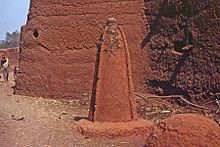
Stewart Guthrie expressed criticism of Bird-David's attitude towards animism, assertive that it promulgated the view that "the earth is in big mensurate whatsoever our local imagination makes it". This, he felt, would result in anthropology abandoning "the scientific project".[41]
Similar Bird-David, Tim Ingold argues that animists practice not come across themselves as separate from their environment:[42]
Hunter-gatherers practice not, equally a rule, approach their environment as an external earth of nature that has to exist 'grasped' intellectually … indeed the separation of mind and nature has no place in their thought and practice.
Rane Willerslev extends the statement by noting that animists decline this Cartesian dualism and that the animist self identifies with the globe, "feeling at once within and autonomously from it so that the two glide ceaselessly in and out of each other in a sealed circuit".[43] The animist hunter is thus aware of himself every bit a human hunter, but, through mimicry, is able to assume the viewpoint, senses, and sensibilities of his prey, to exist i with it.[44] Shamanism, in this view, is an everyday attempt to influence spirits of ancestors and animals, by mirroring their behaviors, as the hunter does its prey.
Upstanding and ecological understanding [edit]
Cultural ecologist and philosopher David Abram promotes an ethical and ecological understanding of animism, grounded in the phenomenology of sensory experience. In his books The Spell of the Sensuous, and Becoming Animal, Abram suggests that material things are never entirely passive in our direct perceptual experience, holding rather that perceived things actively "solicit our attention" or "call our focus", coaxing the perceiving body into an ongoing participation with those things.[45] [46]
In the absence of intervening technologies, he suggests, sensory experience is inherently animistic in that it discloses a material field that is animate and self-organizing from the offset. Cartoon upon contemporary cognitive and natural science, likewise every bit upon the perspectival worldviews of diverse indigenous oral cultures, Abram proposes a richly pluralist and story-based cosmology in which thing is alive. He suggests that such a relational ontology is in shut accord with our spontaneous perceptual experience; it would draw us back to our senses, and to the primacy of the sensuous terrain, enjoining a more than respectful and upstanding relation to the more than-than-man community of animals, plants, soils, mountains, waters, and weather-patterns that materially sustains us.[45] [46]
In dissimilarity to a long-standing tendency in the Western social sciences, which commonly provide rational explanations of animistic experience, Abram develops an animistic business relationship of reason itself. He holds that civilized reason is sustained only past intensely animistic participation between homo beings and their own written signs. For example, equally soon as nosotros plow our gaze toward the alphabetic letters written on a folio or a screen, we "see what they say"—the letters, that is, seem to speak to us—much every bit spiders, trees, gushing rivers and lichen-encrusted boulders once spoke to our oral ancestors. For Abram, reading tin can usefully be understood as an intensely concentrated form of animism, one that effectively eclipses all of the other, older, more than spontaneous forms of animistic participation in which we once engaged.
To tell the story in this manner—to provide an animistic business relationship of reason, rather than the other mode around—is to imply that animism is the wider and more inclusive term and that oral, mimetic modes of experience still underlie, and back up, all our literate and technological modes of reflection. When reflection's rootedness in such bodily, participatory modes of experience is entirely unacknowledged or unconscious, reflective reason becomes dysfunctional, unintentionally destroying the corporeal, sensuous world that sustains it.[47]
Relation to the concept of 'I-thou' [edit]
Religious studies scholar Graham Harvey divers animism as the conventionalities "that the world is full of persons, only some of whom are human, and that life is e'er lived in relationship with others".[17] He added that it is therefore "concerned with learning how to be a adept person in respectful relationships with other persons".[17]
In his Handbook of Contemporary Animism (2013), Harvey identifies the animist perspective in line with Martin Buber'southward "I-thou" as opposed to "I-information technology". In such, Harvey says, the animist takes an I-thou arroyo to relating to the earth, whereby objects and animals are treated as a "thou", rather than every bit an "information technology".[48]
Organized religion [edit]
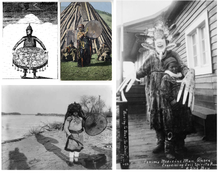
A tableau presenting figures of various cultures filling in mediator-like roles, often being termed as "shaman" in the literature.
There is ongoing[ when? ] disagreement (and no general consensus) as to whether animism is just a singular, broadly encompassing religious belief[49] or a worldview in and of itself, comprising many diverse mythologies found worldwide in many diverse cultures.[50] [51] This also raises a controversy regarding the ethical claims animism may or may not make:[ according to whom? ] whether animism ignores questions of ethics altogether;[52] or, by endowing diverse non-human being elements of nature with spirituality or personhood,[53] in fact promotes a complex ecological ethics.[54]
Concepts [edit]
Distinction from pantheism [edit]
Animism is non the same as pantheism, although the two are sometimes confused. Moreover, some religions are both pantheistic and animistic. 1 of the main differences is that while animists believe everything to be spiritual in nature, they do not necessarily encounter the spiritual nature of everything in existence as being united (monism), the fashion pantheists exercise. As a result, animism puts more than emphasis on the uniqueness of each private soul. In pantheism, everything shares the same spiritual essence, rather than having distinct spirits or souls.[55] [56]
Fetishism / totemism [edit]
In many animistic globe views, the human being is often regarded equally on a roughly equal footing with other animals, plants, and natural forces.[57]
African indigenous religions [edit]
Traditional African religions: most religious traditions of Sub-Saharan Africa, which are basically a complex form of animism with polytheistic and shamanistic elements and ancestor worship.[58]
In Due north Africa, the traditional Berber religion includes the traditional polytheistic, animist, and in some rare cases, shamanistic, religions of the Berber people.
Asian origin religions [edit]
Indian-origin religions [edit]
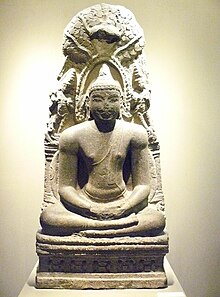
Sculpture of the Buddha meditating under the Maha Bodhi Tree of Bodh Gaya in Bharat.
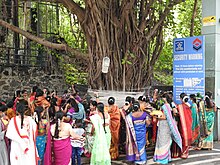
During Vat Purnima festival married women tying threads around a banyan tree.
In the Indian-origin religions, namely Hinduism, Buddhism, Jainism, and Sikhism, the animistic aspects of nature worship and ecological conservation are part of the core conventionalities system.
Matsya Purana, a Hindu text, has a Sanskrit language shloka (hymn), which explains the importance of reverence of ecology. It states, "A swimming equals ten wells, a reservoir equals ten ponds, while a son equals ten reservoirs, and a tree equals ten sons."[59] Indian religions worship copse such as the Bodhi Tree and numerous superlative banyan copse, conserve the sacred groves of India, revere the rivers equally sacred, and worship the mountains and their environmental.
Panchavati are the sacred trees in Indic religions, which are sacred groves containing five type of trees, commonly chosen from amongst the Vata (Ficus benghalensis, Banyan), Ashvattha (Ficus religiosa, Peepal), Bilva (Aegle marmelos, Bengal Quince), Amalaki (Phyllanthus emblica, Indian Gooseberry, Amla), Ashoka (Saraca asoca, Ashok), Udumbara (Ficus racemosa, Cluster Fig, Gular), Nimba (Azadirachta indica, Neem) and Shami (Prosopis spicigera, Indian Mesquite).[60] [61]

The banyan is considered holy in several religious traditions of Republic of india. The Ficus benghalensis is the national tree of India.[62] Vat Purnima is a Hindu festival related to the banyan tree, and is observed by married women in North India and in the Western Indian states of Maharashtra, Goa, Gujarat.[63] For 3 days of the month of Jyeshtha in the Hindu calendar (which falls in May–June in the Gregorian calendar) married women detect a fast, tie threads around a banyan tree, and pray for the well-beingness of their husbands.[64] Thimmamma Marrimanu, sacred to Indian religions, has branches spread over v acres and was listed as the earth's largest banyan tree in the Guinness Earth Records in 1989.[65] [66]
In Hinduism, the foliage of the banyan tree is said to be the resting place for the god Krishna. In the Bhagavat Gita, Krishna said, "In that location is a banyan tree which has its roots upward and its branches down, and the Vedic hymns are its leaves. One who knows this tree is the knower of the Vedas." (Bg xv.1) Here the cloth world is described as a tree whose roots are upwardly and branches are below. We accept feel of a tree whose roots are upward: if one stands on the bank of a river or any reservoir of water, he tin can see that the trees reflected in the water are upside downwardly. The branches go downwards and the roots upwards. Similarly, this fabric world is a reflection of the spiritual world. The textile globe is just a shadow of reality. In the shadow there is no reality or substantiality, merely from the shadow we tin can sympathise that there is substance and reality.
In Buddhism'south Pali canon, the banyan (Pali: nigrodha)[67] is referenced numerous times.[68] Typical metaphors allude to the banyan'south epiphytic nature, likening the banyan's supplanting of a host tree as comparable to the manner sensual desire (kāma) overcomes humans.[69]
Mun (also known as Munism or Bongthingism) is the traditional polytheistic, animist, shamanistic, and syncretic religion of the Lepcha people.[70] [71] [72]
Japan and Shinto [edit]
![[icon]](https://upload.wikimedia.org/wikipedia/commons/thumb/1/1c/Wiki_letter_w_cropped.svg/20px-Wiki_letter_w_cropped.svg.png) | This department needs expansion. Yous tin can help by adding to it. (July 2021) |
Shinto, including the Ryukyuan religion, is the traditional Japanese folk religion and has many animist aspects.
Kalash people [edit]
| | This department needs expansion. You can help by adding to it. (July 2021) |
Kalash people of Northern Pakistan follow an ancient animistic faith identified with an aboriginal form of Hinduism.[73]
Korea [edit]
| | This section needs expansion. You can help by calculation to it. (July 2021) |
Muism, the native Korean belief, has many animist aspects.[74]
Philippines' native belief [edit]

A 1922 photograph of an Itneg priestess in the Philippines making an offering to an apdel, a guardian anito spirit of her village that reside in the water-worn stones known as pinaing.[75]
In the ethnic religious behavior of the Philippines, pre-colonial religions of Philippines and Philippine mythology, animism is part of their core beliefs as demonstrated past the belief in Anito and Bathala every bit well equally their conservation and veneration of sacred Indigenous Philippine shrines, forests, mountains and sacred grounds.
Anito (lit. '[ancestor] spirit') refers to the various ethnic shamanistic folk religions of the Philippines, led by female or feminized male person shamans known every bit babaylan. It includes belief in a spirit world existing aslope and interacting with the material earth, as well equally the conventionalities that everything has a spirit, from rocks and copse to animals and humans to natural phenomena.[76] [77]
In indigenous Filipino belief, the Bathala is the omnipotent deity which was derived from Sanskrit word for the Hindu supreme deity bhattara,[78] [79] equally one of the x avatars of the Hindu god Vishnu.[eighty] [81] The omnipotent Bathala also presides over the spirits of ancestors chosen Anito.[82] [83] [84] [85] Anitos serve as intermediaries between mortals and the divine, such equally Agni (Hindu) who holds the access to divine realms; for this reason they are invoked beginning and are the first to receive offerings, regardless of the deity the worshipper wants to pray to.[86] [87]
Abrahamic religions [edit]
The Old Attestation and the Wisdom literature preach the omnipresence of God (Jeremiah 23:24; Proverbs 15:3; 1 Kings 8:27). God is bodily present in the Incarnation (Christianity) of his Son, Jesus Christ. (Gospel of John 1:14, Colossians ii:ix).[88]
With rising awareness of ecological preservation, recently theologians similar Mark I. Wallace argue for animistic Christianity with a biocentric approach that understands God being present in all earthly objects, such every bit animals, trees, and rocks.[89]
Pre-Islamic Arab religion [edit]
| | This section needs expansion. You tin help by adding to it. (July 2021) |
Pre-Islamic Arab faith can refer to the traditional polytheistic, animist, and in some rare cases, shamanistic, religions of the peoples of the Arabian people. The belief in jinn, invisible entities alike to spirits in the Western sense dominant in the Arab religious systems, hardly fit the description of Animism in a strict sense. The jinn are considered to be analogous to the human soul by living lives similar that of humans, only they are non exactly like homo souls neither are they spirits of the dead.[90] : 49 Information technology is unclear if belief in jinn derived from nomadic or sedentary populations.[90] : 51
Neopagan and New Age movements [edit]
Some Neopagan groups, including Eco-pagans, draw themselves as animists, significant that they respect the various community of living beings and spirits with whom humans share the earth and cosmos.[91]
The New Age motion commonly demonstrates animistic traits in asserting the existence of nature spirits.[92]
Shamanism [edit]
A shaman is a person regarded as having access to, and influence in, the world of benevolent and malevolent spirits, who typically enters into a trance state during a ritual, and practices divination and healing.[93]
According to Mircea Eliade, shamanism encompasses the premise that shamans are intermediaries or messengers between the man world and the spirit worlds. Shamans are said to care for ailments and illnesses by mending the soul. Alleviating traumas affecting the soul or spirit restores the physical body of the individual to residual and wholeness. The shaman also enters supernatural realms or dimensions to obtain solutions to problems afflicting the customs. Shamans may visit other worlds or dimensions to bring guidance to misguided souls and to ameliorate illnesses of the man soul caused by strange elements. The shaman operates primarily inside the spiritual world, which in turn affects the human world. The restoration of remainder results in the elimination of the ailment.[94]
Abram, however, articulates a less supernatural and much more ecological understanding of the shaman'due south part than that propounded by Eliade. Drawing upon his own field inquiry in Indonesia, Nepal, and the Americas, Abram suggests that in animistic cultures, the shaman functions primarily as an intermediary between the human being community and the more-than-man community of active agencies—the local animals, plants, and landforms (mountains, rivers, forests, winds, and weather patterns, all of which are felt to have their ain specific sentience). Hence, the shaman's ability to heal individual instances of dis-ease (or imbalance) within the man community is a byproduct of their more continual do of balancing the reciprocity between the human being customs and the wider commonage of breathing beings in which that community is embedded.[95]
Animist life [edit]
Not-human being animals [edit]
Animism entails the belief that "all living things have a soul",[ This quote needs a citation ] and thus, a central concern of animist thought surrounds how animals tin can be eaten, or otherwise used for humans' subsistence needs.[96] The actions of non-human animals are viewed every bit "intentional, planned and purposive",[97] and they are understood to be persons, as they are both live, and communicate with others.[98]
In animist worldviews, not-man animals are understood to participate in kinship systems and ceremonies with humans, as well as having their own kinship systems and ceremonies.[99] Harvey cited an example of an animist understanding of animal behavior that occurred at a powwow held by the Conne River Mi'kmaq in 1996; an eagle flew over the proceedings, circling over the fundamental drum group. The assembled participants called out kitpu ('eagle'), conveying welcome to the bird and expressing pleasure at its beauty, and they after articulated the view that the eagle's actions reflected its approval of the event, and the Mi'kmaq's return to traditional spiritual practices.[100]
Flora [edit]
Some animists as well view plant and fungi life equally persons and interact with them accordingly.[101] The almost common encounter between humans and these plant and fungi persons is with the onetime's collection of the latter for food, and for animists, this interaction typically has to exist carried out respectfully.[102] Harvey cited the instance of Maori communities in New Zealand, who ofttimes offer karakia invocations to sweetness potatoes equally they dig the latter up; while doing so there is an awareness of a kinship human relationship between the Maori and the sweet potatoes, with both understood every bit having arrived in Aotearoa together in the same canoes.[102]
In other instances, animists believe that interaction with plant and fungi persons tin can event in the communication of things unknown or even otherwise unknowable.[101] Among some modern Pagans, for instance, relationships are cultivated with specific trees, who are understood to bestow knowledge or physical gifts, such equally flowers, sap, or forest that can be used as firewood or to fashion into a wand; in render, these Pagans requite offerings to the tree itself, which can come in the form of libations of mead or ale, a drop of blood from a finger, or a strand of wool.[103]
The elements [edit]
Various animistic cultures also encompass stones as persons.[104] Discussing ethnographic work conducted amongst the Ojibwe, Harvey noted that their order generally conceived of stones as being inanimate, but with two notable exceptions: the stones of the Bell Rocks and those stones which are situated below trees struck past lightning, which were understood to have become Thunderers themselves.[105] The Ojibwe conceived of conditions equally being capable of having personhood, with storms being conceived of equally persons known as 'Thunderers' whose sounds conveyed communications and who engaged in seasonal conflict over the lakes and forests, throwing lightning at lake monsters.[105] Wind, similarly, tin be conceived as a person in animistic idea.[106]
The importance of place is also a recurring element of animism, with some places being understood to be persons in their own right.[107]
Spirits [edit]
Animism can also entail relationships existence established with not-corporeal spirit entities.[108]
Other usage [edit]
Science [edit]
In the early 20th century, William McDougall defended a grade of animism in his volume Body and Mind: A History and Defence force of Animism (1911).
Physicist Nick Herbert has argued for "quantum animism" in which the heed permeates the world at every level:
The quantum consciousness assumption, which amounts to a kind of "breakthrough animism" besides asserts that consciousness is an integral part of the physical earth, not an emergent property of special biological or computational systems. Since everything in the world is on some level a quantum system, this supposition requires that everything be conscious on that level. If the world is truly breakthrough animated, then there is an immense amount of invisible inner experience going on all around us that is presently inaccessible to humans, because our own inner lives are imprisoned inside a pocket-size quantum system, isolated deep in the meat of an animate being brain.[109]
Werner Krieglstein wrote regarding his quantum Animism:
Herbert'due south quantum Animism differs from traditional Animism in that information technology avoids assuming a dualistic model of mind and matter. Traditional dualism assumes that some kind of spirit inhabits a trunk and makes information technology move, a ghost in the automobile. Herbert's quantum Animism presents the idea that every natural arrangement has an inner life, a conscious heart, from which information technology directs and observes its action.[110]
In Mistake and Loss: A Licence to Enchantment,[111] Ashley Curtis (2018) has argued that the Cartesian idea of an experiencing subject area facing off with an inert physical earth is incoherent at its very foundation and that this incoherence is predicted rather than belied past Darwinism. Human reason (and its rigorous extension in the natural sciences) fits an evolutionary niche just as echolocation does for bats and infrared vision does for pit vipers, and is—according to western scientific discipline'southward own dictates—epistemologically on par with, rather than superior to, such capabilities. The meaning or aliveness of the "objects" nosotros run across—rocks, copse, rivers, other animals—thus depends its validity non on a detached cerebral judgment, just purely on the quality of our experience. The animist feel, and the wolf's or raven's experience, thus become licensed as every bit valid worldviews to the modern western scientific ane; they are more than valid, since they are not plagued with the incoherence that inevitably crops up[ colloquialism ] when "objective beingness" is separated from "subjective experience".
Socio-political impact [edit]
Harvey opined that animism's views on personhood represented a radical challenge to the dominant perspectives of modernity, because it accords "intelligence, rationality, consciousness, volition, bureau, intentionality, language, and want" to non-humans.[112] Similarly, it challenges the view of human uniqueness that is prevalent in both Abrahamic religions and Western rationalism.[113]
Art and literature [edit]
Animist beliefs can also be expressed through artwork.[114] For instance, amidst the Maori communities of New Zealand, there is an acknowledgement that creating art through carving wood or stone entails violence confronting the wood or stone person and that the persons who are damaged therefore take to be placated and respected during the process; any excess or waste from the cosmos of the artwork is returned to the country, while the artwork itself is treated with item respect.[115] Harvey, therefore, argued that the cosmos of art amid the Maori was non most creating an inanimate object for display, simply rather a transformation of different persons within a relationship.[116]
Harvey expressed the view that animist worldviews were present in various works of literature, citing such examples as the writings of Alan Garner, Leslie Silko, Barbara Kingsolver, Alice Walker, Daniel Quinn, Linda Hogan, David Abram, Patricia Grace, Chinua Achebe, Ursula Le Guin, Louise Erdrich, and Marge Piercy.[117]
Animist worldviews have also been identified in the animated films of Hayao Miyazaki.[118] [119] [120] [121]
Meet as well [edit]
- Anecdotal cognitivism
- Animatism
- Anima mundi
- Ecotheology
- Hylozoism
- Mana
- Mauri (life force)
- Kaitiaki
- Panpsychism
- Religion and environmentalism
- Sacred trees
- Wild fauna totemization
References [edit]
- ^ a b EB (1878).
- ^ Segal 2004, p. 14.
- ^ "Religion and Nature" (PDF).
- ^ a b Stringer, Martin D. (1999). "Rethinking Animism: Thoughts from the Infancy of our Discipline". Journal of the Royal Anthropological Establish. v (four): 541–56. doi:x.2307/2661147. JSTOR 2661147.
- ^ Hornborg, Alf (2006). "Animism, fetishism, and objectivism as strategies for knowing (or non knowing) the earth". Ethnos: Journal of Anthropology. 71 (1): 21–32. doi:x.1080/00141840600603129. S2CID 143991508.
- ^ Haught, John F. What Is Religion? An Introduction. Paulist Press. p. xix.
- ^ Hicks, David (2010). Ritual and Belief: Readings in the Anthropology of Religion (iii ed.). Rowman Altamira. p. 359.
Tylor'south notion of animism—for him the first religion—included the assumption that early Homo sapiens had invested animals and plants with souls ...
- ^ "Animism". Contributed by Helen James; coordinated by Dr. Elliott Shaw with assist from Ian Favell. ELMAR Projection (Academy of Cumbria). 1998–1999.
{{cite spider web}}: CS1 maint: others (link) - ^ "Interesting facts".
- ^ "Native American Religious and Cultural Freedom: An Introductory Essay". The Pluralism Project. President and Fellows of Harvard College and Diana Eck. 2005. Archived from the original on 23 December 2014. Retrieved 4 Oct 2013.
- ^ Bird-David, Nurit (1999). ""Animism" Revisited: Personhood, Environs, and Relational Epistemology". Current Anthropology. forty (S1): S67. doi:10.1086/200061.
- ^ Harvey, Graham (2006). Animism: Respecting the Living World. Columbia Academy Printing. p. 9. ISBN978-0-231-13700-3.
- ^ Harvey 2005, p. seven.
- ^ Harvey 2005, p. five.
- ^ Harvey 2005, pp. three–4.
- ^ Bird-David, Nurit (1999). ""Animism" Revisited: Personhood, Environment, and Relational Epistemology". Current Anthropology. 40 (S1): S67–S68. doi:x.1086/200061.
- ^ a b c d Harvey 2005, p. 11.
- ^ Harvey 2005, p. xiv.
- ^ a b c Harvey 2005, p. xii.
- ^ Sir Edward Burnett Tylor (1871). Primitive Culture: Researches into the Development of Mythology, Philosophy, Organized religion, Fine art, and Custom. J. Murray. p. 260.
- ^ a b Kuper, Adam (2005). Reinvention of Primitive Social club: Transformations of a Myth (2nd ed.). Florence, KY, Us: Routledge. p. 85.
- ^ a b Harvey 2005, p. 6.
- ^ Harvey 2005, p. 8.
- ^ Insoll 2004, p. 29.
- ^ Kuper, Adam (1988). The Invention of Primitive Society: Transformations of an illusion. London: Routledge & Kegan Paul. pp. vi–7.
- ^ Harvey 2005, p. xiii.
- ^ a b c Bird-David, Nurit (1999). ""Animism" Revisited: Personhood, environment, and relational epistemology". Current Anthropology. twoscore (S1): S68. doi:x.1086/200061.
- ^ Ingold, Tim. 2000. "Totemism, Animism, and the Depiction of Animals." In The Perception of the Environment: Essays on Livelihood, Habitation and Skill. London: Routledge. pp. 112–13.
- ^ a b Harvey 2005, p. 14.
- ^ Harvey 2005, p. 15.
- ^ Harvey 2005, p. 16.
- ^ Guthrie 2000, p. 106.
- ^ Harvey 2005, pp. xii, iii.
- ^ Harvey 2005, p. xv.
- ^ Harvey 2005, p. 17.
- ^ a b c Harvey 2005, p. eighteen.
- ^ Harvey 2005, p. xix.
- ^ Harvey 2005, p. xx.
- ^ Harvey 2005, p. 21.
- ^ Hornborg, Alf (2006). "Animism, fetishism, and objectivism as strategies for knowing (or non knowing) the globe". Ethnos. 71 (1): 22–iv. doi:10.1080/00141840600603129. S2CID 143991508.
- ^ Guthrie 2000, p. 107.
- ^ Ingold, Tim (2000). The Perception of the Environs: Essays in livelihood, dwelling, and skill . New York: Routledge. p. 42.
- ^ Willerslev, Rane (2007). Soul Hunters: Hunting, animism, and personhood among the Siberian Yukaghirs . Berkeley: University of California Printing. p. 24. ISBN9780520252172.
- ^ Willerslev, Rane (2007). Soul Hunters: Hunting, animism, and personhood among the Siberian Yukaghirs . Berkeley: University of California Press. p. 27. ISBN9780520252172.
- ^ a b Abram, David. [1996] 1997. The Spell of the Sensuous: Perception and Language in a More-than-Human World. Vintage. ISBN 978-0-679-77639-0.
- ^ a b Abram, David. [2010] 2011. Condign Animal: An Earthly Cosmology. Vintage. ISBN 978-0-375-71369-ix.
- ^ Abram, David (1996). The Spell of the Sensuous . New York: Pantheon. p. 303. ISBN9780679438199.
- ^ Harvey, Graham (2013). The Handbook of Contemporary Animism. London, UK: Routledge.
- ^ David A. Leeming; Kathryn Madden; Stanton Marlan (half-dozen November 2009). Encyclopedia of Psychology and Faith. Springer. p. 42. ISBN978-0-387-71801-9.
- ^ Harvey (2006), p. 6.
- ^ Quinn, Daniel (2012). "Q and A #400". Ishmael.org. Archived from the original on 23 September 2011.
- ^ Edward Burnett Tylor (1920). Primitive culture: researches into the development of mythology, philosophy, religion, language, art, and custom. J. Murray. p. 360.
- ^ Clarke, Peter B., and Peter Beyer, eds. 2009. The World's Religions: Continuities and Transformations. London: Routledge. p. 15.
- ^ Back-scratch, Patrick (2011). Ecological Ethics (2 ed.). Cambridge: Polity. pp. 142–iii. ISBN978-0-7456-5126-two.
- ^ Harrison, Paul A. 2004. Elements of Pantheism. p. 11.
- ^ McColman, Carl. 2002. When Someone You Love Is Wiccan: A Guide to Witchcraft and Paganism for Concerned Friends, Nervous parents, and Curious Co-Workers. p. 97.
- ^ Fernandez-Armesto, p. 138.
- ^ Vontress, Clemmont Due east. (2005). "Animism: Foundation of Traditional Healing in Sub-Saharan Africa". Integrating Traditional Healing Practices into Counseling and Psychotherapy. SAGE Publications, Inc. pp. 124–137. doi:10.4135/9781452231648. ISBN9780761930471 . Retrieved 1 Nov 2019.
- ^ "Haryana mulls giving marks to course 12 students for planting trees", Hindustan Times, 26 July 2021.
- ^ "Panchvati trees", greenmesg.org, accessed 26 July 2021.
- ^ "Peepal for east amla for westward", Times of India, 26 July 2021.
- ^ "National Tree". Government of India. Retrieved sixteen Jan 2012.
- ^ Kerkar, Rajendra P (7 June 2009). "Vat-Pournima: Worship of the banyan tree". The Times of India . Retrieved xviii July 2021.
- ^ "Mumbai: Women celebrate Vat Purnima at Jogeshwari station". Mid Twenty-four hours. two June 2015. Retrieved 18 July 2021.
- ^ "Archived copy". Archived from the original on 10 July 2012. Retrieved eighteen Jan 2015.
{{cite web}}: CS1 maint: archived copy every bit championship (link) - ^ "Thimmamma Marrimanu – Anantapur". Anantapur.com . Retrieved xix March 2019.
- ^ Rhys Davids, T. W.; Stede, William, eds. (1921–1925). "Nigrodha". The Pali Text Society's Pali-English dictionary. Chipstead, London: Pali Text Social club. p. 355. Retrieved 22 November 2008.
- ^ Run across, for example, the automated search of the SLTP ed. of the Pali Catechism for the root "nigrodh" which results in 243 matches "Search term 'Nigrodh' found in 243 pages in all documents". Bodhgayanews.net. Archived from the original on 2 December 2008. Retrieved 22 November 2008.
- ^ See, eastward.k., SN 46.39, "Copse [Discourse]", trans. by Bhikkhu Bodhi (2000), Connected Discourses of the Buddha: A Translation of the Saṃyutta Nikāya (Boston: Wisdom Publications), pp. 1593, 1906 n. 81; and, Sn 2.five v. 271 or 272 (Fausböll, 1881, p. 46).
- ^ Bareh, Hamlet, ed. (2001). "Sikkim". Encyclopaedia of N-East Republic of india. Vol. 7. Mittal Publications. pp. 284–86. ISBN81-7099-787-9.
- ^ Torri, Davide (2010). "10. In the Shadow of the Devil: Traditional patterns of Lepcha culture reinterpreted". In Ferrari, Fabrizio (ed.). Health and Religious Rituals in South Asia. Taylor & Francis. pp. 149–156. ISBN978-1-136-84629-8.
- ^ West, Barbara A., ed. (2009). Encyclopedia of the Peoples of Asia and Oceania. Facts on File Library of World History. Infobase. p. 462. ISBN978-ane-4381-1913-seven.
- ^ Zeb, Alam, et al. (2019). "Identifying local actors of deforestation and forest degradation in the Kalasha valleys of Pakistan." Forest Policy and Economics 104: 56–64.
- ^ Lee, Peter H.; De Bary, Wm. Theodore (1996). Sources of Korean tradition. New York: Columbia University Press. ISBN0-231-10566-5. OCLC 34553561.
- ^ Fay-Cooper Cole; Albert Gale (1922). "The Tinguian; Social, Religious, and Economic life of a Philippine tribe". Field Museum of Natural History: Anthropological Series. fourteen (2): 235–493.
- ^ Scott, William Henry (1994). Barangay: Sixteenth century Philippine culture and society. Quezon City: Ateneo de Manila University Press. ISBN978-9715501354.
- ^ Demetrio, Francisco R.; Cordero-Fernando, Gilda; Nakpil-Zialcita, Roberto B.; Feleo, Fernando (1991). The Soul Book: Introduction to Philippine heathen religion. Quezon Metropolis: GCF Books. ASIN B007FR4S8G.
- ^ R. Ghose (1966), Saivism in Republic of indonesia during the Hindu-Javanese period, The Academy of Hong Kong Press, pages sixteen, 123, 494–495, 550–552
- ^ Scott, William Henry (1994). Barangay: Sixteenth Century Philippine Culture and Social club. Quezon City: Ateneo de Manila University Press. ISBN 971-550-135-four. p. 234.
- ^ de los Reyes y Florentino, Isabelo (2014). History of Ilocos, Book ane. University of the Philippines Press, 2014. ISBN 9715427294, 9789715427296. p. 83.
- ^ John Crawfurd (2013). History of the Indian Archipelago: Containing an Account of the Manners, Fine art, Languages, Religions, Institutions, and Commerce of Its Inhabitants. Cambridge University Press. pp. 219–220. ISBN 978-i-108-05615-1.
- ^ Marsden, William (1784). The History of Sumatra: Containing an Account of the Authorities, Laws, Community and Manners of the Native Inhabitants. Practiced Press, 2019.
- ^ Marsden, William (1784). The History of Sumatra: Containing an Account of the Government, Laws, Customs and Manners of the Native Inhabitants, with a Description of the Natural Productions, and a Relation of the Ancient Political State of that Island. p. 255.
- ^ Silliman, Robert Benton (1964). Religious Beliefs and Life at the Beginning of the Spanish Regime in the Philippines: Readings. College of Theology, Silliman University, 1964. p. 46
- ^ Blair, Emma Helen & Robertson, James Alexander. The Philippine Islands, 1493–1898, Volume twoscore (of 55): 1690–1691. Chapter Xv, p. 106.
- ^ Talbott, Rick F. (2005). Sacred Sacrifice: Ritual Paradigms in Vedic Religion and Early on Christianity. Wipf and Stock Publishers, 2005. ISBN 1597523402, 9781597523400. p. 82
- ^ Pomey, François & Tooke, Andrew (1793). The Pantheon: Representing the Fabled Histories of the Heathen Gods, and the Most Illustrious Heroes of Antiquity, in a Brusque, Plain, and Familiar Method, past Style of Dialogue, for the Utilize of Schools. Silvester Doig, 1793. p. 151
- ^ Wallace, Mark I. (2013). "Christian Animism, Green Spirit Theology, and the Global Crisis today". Interdisciplinary and Religio-Cultural Discourses on a Spirit-Filled Earth. Palgrave Macmillan. doi:ten.1057/9781137268990.0023. ISBN9781137268990 . Retrieved 10 November 2021.
- ^ "Theologian Mark Wallace Explores Christian Animism in Recent Book". www.swarthmore.edu. xv October 2020. Retrieved 8 Dec 2020.
- ^ a b Magic and Divination in Early on Islam. (2021). Vereinigtes Königreich: Taylor & Francis.
- ^ Pizza, Murphy, and James R. Lewis. 2008. Handbook of Contemporary Paganism. pp. 408–09.
- ^ Hanegraaff, Wouter J. 1998. New Age Faith and Western Culture. p. 199.
- ^ "Shaman." Lexico. Oxford University Press and Dictionary.com. Retrieved 25 July 2020.
- ^ Eliadem Mircea. 1972. Shamanism: Archaic Techniques of Ecstasy, Bollingen Series LXXVI. Princeton University Press. pp. 3–7.
- ^ Abram, David (1996). The Spell of the Sensuous . New York: Pantheon. pp. 3–29. ISBN9780679438199.
- ^ Harvey 2005, p. 99.
- ^ Harvey 2005, p. 101.
- ^ Harvey 2005, p. 100.
- ^ Harvey 2005, p. 102.
- ^ Harvey 2005, pp. 102–103.
- ^ a b Harvey 2005, p. 104.
- ^ a b Harvey 2005, p. 106.
- ^ Harvey 2005, pp. 104–105.
- ^ Harvey 2005, pp. 106–107.
- ^ a b Harvey 2005, p. 107.
- ^ Harvey 2005, pp. 108–109.
- ^ Harvey 2005, p. 109.
- ^ Harvey 2005, p. 122.
- ^ Herbert, Nick (2002). "Holistic Physics – or – An Introduction to Quantum Tantra". southerncrossreview.org. Retrieved 1 May 2014.
- ^ Werner J. Krieglstein Compassion: A New Philosophy of the Other 2002, p. 118
- ^ Curtis, Ashley (2018). Error and Loss: A Licence to Enchantment. Zürich: Kommode Verlag. ISBN978-3952462690.
- ^ Harvey 2005, p. 18.
- ^ Harvey 2005, p. xix.
- ^ Harvey 2005, p. l.
- ^ Harvey 2005, p. 55.
- ^ Harvey 2005, p. 64.
- ^ Harvey 2005, p. xxiii.
- ^ Robert Epstein (31 January 2010). "Spirits, gods and pastel paints: The weird world of master animator Hayao Miyazaki". The Independent. Archived from the original on 7 May 2022. Retrieved ane June 2018.
- ^ Dr. David A. Ross (19 Apr 2011). "Musings on Miyazaki". Kyoto Journal. Archived from the original on 9 June 2017. Retrieved 1 June 2018.
- ^ Ogihara-Schuck, Eriko (16 Oct 2014). Miyazaki'south Animism Abroad: The Reception of Japanese Religious Themes by American and German Audiences. McFarland. ISBN978-0786472628.
- ^ Lewis Bond (6 October 2015). "Hayao Miyazaki - The Essence of Humanity". YouTube.com. Channel Criswell. Archived from the original on nine October 2015. Retrieved 1 June 2018.
Sources [edit]
- Abram, David (1996). The Spell of the Sensuous: Perception and Language in a More-than-Human World . New York: Pantheon Books. ISBN9780679438199.
- Adler, Margot (2006) [1979]. Drawing Down the Moon: Witches, Druids, Goddess-Worshippers and Other Pagans in America (Revised ed.). London: Penguin. ISBN978-0-14-303819-1.
- Armstrong, Karen (1994). A History of God: The 4,000-Yr Quest of Judaism, Christianity and Islam. Ballantine Books.
- Bird-David, Nurit (2000). ""Animism" Revisited: Personhood, Environment, and Relational Epistemology". Electric current Anthropology. 41 (S1): 67–91. doi:10.1086/200061.
- Curtis, Ashley (2018). Fault and Loss: A Licence to Enchantment. Zürich: Kommode Verlag.
- Dean, Bartholomew (2009). Urarina Society, Cosmology, and History in Peruvian Amazonia. Gainesville: University Press of Florida. ISBN978-0-8130-3378-five.
- Fernandez-Armesto, Felipe (2003). Ideas that Changed the Earth. Dorling Kindersley.
- Forbes, Andrew; Henley, David (2012). "Lamphun'southward Little-Known Animal Shrines (Animist traditions in Thailand)". Aboriginal Chiang Mai. Vol. 1. Chiang Mai: Cognoscenti Books.
- Guthrie, Stewart (2000). "On Animism". Current Anthropology. 41 (1): 106–107. doi:x.1086/300107. JSTOR 10.1086/300107. PMID 10593728. S2CID 224796411.
- Harvey, Graham (2005). Animism: Respecting the Living World. London: Hurst & Co. ISBN978-0-231-13701-0.
- Insoll, Timothy (2004). Archæology, Ritual, Religion. London: Routledge. ISBN978-0-415-25312-3.
- Lonie, Alexander Charles Oughter (1878). . In Baynes, T. S. (ed.). Encyclopædia Britannica. Vol. 2 (ninth ed.). New York: Charles Scribner'southward Sons. pp. 55–57.
- Segal, Robert (2004). Myth: A Very Brusk Introduction. Oxford University Press.
- "Animism". The Columbia Encyclopedia (sixth ed.). Bartleby.com Inc. 2007. Archived from the original on 9 February 2007.
Further reading [edit]
- Abram, David. 2010. Becoming Beast: An Earthly Cosmology (New York: Pantheon Books)
- Badenberg, Robert. 2007. "How most 'Animism'? An Inquiry beyond Label and Legacy." In Mission als Kommunikation: Festschrift für Ursula Wiesemann zu ihrem 75, Geburtstag, edited past M. West. Müller. Nürnberg: VTR (ISBN 978-3-937965-75-8) and Bonn: VKW (ISBN 978-3-938116-33-3).
- Hallowell, Alfred Irving. 1960. "Ojibwa ontology, beliefs, and world view." In Culture in History, edited by Due south. Diamond. (New York: Columbia University Press).
- Reprint: 2002. Pp. 17–49 in Readings in Indigenous Religions, edited past G. Harvey. London: Continuum.
- Harvey, Graham. 2005. Animism: Respecting the Living Earth. London: Hurst & Co.
- Ingold, Tim. 2006. "Rethinking the breathing, re-animating thought." Ethnos 71(1):9–20.
- Käser, Lothar. 2004. Animismus. Eine Einführung in die begrifflichen Grundlagen des Welt- und Menschenbildes traditionaler (ethnischer) Gesellschaften für Entwicklungshelfer und kirchliche Mitarbeiter in Übersee. Bad Liebenzell: Liebenzeller Mission. ISBN iii-921113-61-10.
- mit dem verkürzten Untertitel Einführung in seine begrifflichen Grundlagen auch bei: Erlanger Verlag für Mission und Okumene, Neuendettelsau 2004, ISBN 3-87214-609-2
- Quinn, Daniel. [1996] 1997. The Story of B: An Adventure of the Mind and Spirit. New York: Bantam Books.
- Thomas, Northcote Whitridge (1911). . In Chisholm, Hugh (ed.). Encyclopædia Britannica. Vol. 2 (11th ed.). Cambridge University Printing. pp. 53–55.
- Wundt, Wilhelm. 1906. Mythus und Religion, Teil II. Leipzig 1906 (Völkerpsychologie II)
External links [edit]
- Animism, Rinri, Modernization; the Base of Japanese Robotics
- Urban Legends Reference Pages: Weight of the Soul
- Animist Network
Source: https://en.wikipedia.org/wiki/Animism
Posted by: griffithboakist.blogspot.com
0 Response to "What Is The Old Stone Age Belief That Spirits And Forces Reside In Animals"
Post a Comment