

What Is The Main Function Of The Golgi In An Animal Cell
The Golgi apparatus, or Golgi complex, functions equally a manufacturing plant in which proteins received from the ER are further processed and sorted for transport to their eventual destinations: lysosomes, the plasma membrane, or secretion. In add-on, as noted earlier, glycolipids and sphingomyelin are synthesized within the Golgi. In constitute cells, the Golgi apparatus further serves equally the site at which the complex polysaccharides of the cell wall are synthesized. The Golgi apparatus is thus involved in processing the broad range of cellular constituents that travel forth the secretory pathway.
Organization of the Golgi
Morphologically the Golgi is composed of flattened membrane-enclosed sacs (cisternae) and associated vesicles (Figure ix.22). A striking feature of the Golgi appliance is its singled-out polarity in both structure and function. Proteins from the ER enter at its cis face up (entry face), which is convex and commonly oriented toward the nucleus. They are then transported through the Golgi and go out from its concave trans confront (exit face). As they pass through the Golgi, proteins are modified and sorted for transport to their eventual destinations within the cell.
Figure 9.22
Electron micrograph of a Golgi apparatus. The Golgi appliance consists of a stack of flattened cisternae and associated vesicles. Proteins and lipids from the ER enter the Golgi apparatus at its cis face and get out at its trans confront. (Courtesy of Dr. L. (more...)
Singled-out processing and sorting events announced to take place in an ordered sequence within different regions of the Golgi complex, then the Golgi is ordinarily considered to consist of multiple discrete compartments. Although the number of such compartments has not been established, the Golgi is most ordinarily viewed as consisting of four functionally distinct regions: the cis Golgi network, the Golgi stack (which is divided into the medial and trans subcompartments), and the trans Golgi network (Figure 9.23). Proteins from the ER are transported to the ER-Golgi intermediate compartment and and then enter the Golgi apparatus at the cis Golgi network. They then progress to the medial and trans compartments of the Golgi stack, within which nigh metabolic activities of the Golgi apparatus accept place. The modified proteins, lipids, and polysaccharides then move to the trans Golgi network, which acts as a sorting and distribution center, directing molecular traffic to lysosomes, the plasma membrane, or the jail cell exterior.

Figure 9.23
Regions of the Golgi apparatus. Vesicles from the ER fuse to form the ER-Golgi intermediate compartment, and proteins from the ER are then transported to the cis Golgi network. Resident ER proteins are returned from the ER-Golgi intermediate compartment (more than...)
Although the Golgi apparatus was offset described over 100 years ago, the mechanism by which proteins move through the Golgi appliance has notwithstanding non been established and is an area of controversy among cell biologists. One possibility is that transport vesicles bear proteins betwixt the cisternae of the Golgi compartments. However, in that location is considerable experimental support for an culling model proposing that proteins are just carried through compartments of the Golgi within the Golgi cisternae, which gradually mature and progressively move through the Golgi in the cis to trans direction.
Poly peptide Glycosylation inside the Golgi
Poly peptide processing within the Golgi involves the modification and synthesis of the carbohydrate portions of glycoproteins. One of the major aspects of this processing is the modification of the N-linked oligosaccharides that were added to proteins in the ER. As discussed earlier in this chapter, proteins are modified inside the ER past the addition of an oligosaccharide consisting of xiv sugar residues (see Effigy 9.xv). 3 glucose residues and ane mannose are then removed while the polypeptides are still in the ER. Post-obit ship to the Golgi apparatus, the N-linked oligosaccharides of these glycoproteins are subject field to extensive further modifications.
N-linked oligosaccharides are processed inside the Golgi apparatus in an ordered sequence of reactions (Figure 9.24). The offset modification of proteins destined for secretion or for the plasma membrane is the removal of three additional mannose residues. This is followed past the sequential improver of an North-acetylglucosamine, the removal of 2 more than mannoses, and the add-on of a fucose and two more N-acetylglucosamines. Finally, three galactose and 3 sialic acid residues are added. As noted in Chapter 7, dissimilar glycoproteins are modified to different extents during their passage through the Golgi, depending on both the structure of the protein and on the amount of processing enzymes that are nowadays within the Golgi complexes of dissimilar types of cells. Consequently, proteins can emerge from the Golgi with a variety of different N-linked oligosaccharides.

Figure nine.24
Processing of N-linked oligosaccharides in the Golgi. The N-linked oligosaccharides of glycoproteins transported from the ER are further modified past an ordered sequence of reactions in the Golgi.
The processing of the North-linked oligosaccharide of lysosomal proteins differs from that of secreted and plasma membrane proteins. Rather than the initial removal of three mannose residues, proteins destined for incorporation into lysosomes are modified by mannose phosphorylation. In the first step of this reaction, N-acetylglucosamine phosphates are added to specific mannose residues, probably while the poly peptide is still in the cis Golgi network (Figure 9.25). This is followed by removal of the N-acetylglucosamine grouping, leaving mannose-6-phosphate residues on the N-linked oligosaccharide. Considering of this modification, these residues are not removed during further processing. Instead, these phosphorylated mannose residues are specifically recognized by a mannose-half-dozen-phosphate receptor in the trans Golgi network, which directs the ship of these proteins to lysosomes.

Figure 9.25
Targeting of lysosomal proteins past phosphorylation of mannose residues. Proteins destined for incorporation into lysosomes are specifically recognized and modified by the addition of phosphate groups to the six position of mannose residues. In the outset (more than...)
The phosphorylation of mannose residues is thus a critical step in sorting lysosomal proteins to their correct intracellular destination. The specificity of this process resides in the enzyme that catalyzes the first step in the reaction sequence—the selective addition of North-acetylglucosamine phosphates to lysosomal proteins. This enzyme recognizes a structural determinant that is present on lysosomal proteins merely non on proteins destined for the plasma membrane or secretion. This recognition determinant is not a simple sequence of amino acids; rather, it is formed in the folded protein by the juxtaposition of amino acrid sequences from different regions of the polypeptide concatenation. In dissimilarity to the bespeak sequences that directly poly peptide translocation to the ER, the recognition determinant that leads to mannose phosphorylation, and thus ultimately targets proteins to lysosomes, depends on the iii-dimensional conformation of the folded protein. Such determinants are chosen signal patches, in contrast to the linear targeting signals discussed before in this chapter.
Proteins can also be modified by the addition of carbohydrates to the side chains of acceptor serine and threonine residues within specific sequences of amino acids (O-linked glycosylation) (encounter Figure 7.28). These modifications have place in the Golgi apparatus by the sequential addition of single sugar residues. The serine or threonine is usually linked directly to Northward-acetylgalactosamine, to which other sugars can and so be added. In some cases, these sugars are farther modified by the addition of sulfate groups.
Lipid and Polysaccharide Metabolism in the Golgi
In addition to its activities in processing and sorting glycoproteins, the Golgi appliance functions in lipid metabolism—in item, in the synthesis of glycolipids and sphingomyelin. Every bit discussed earlier, the glycerol phospholipids, cholesterol, and ceramide are synthesized in the ER. Sphingomyelin and glycolipids are then synthesized from ceramide in the Golgi apparatus (Figure ix.26). Sphingomyelin (the only nonglycerol phospholipid in cell membranes) is synthesized by the transfer of a phosphorylcholine group from phosphatidylcholine to ceramide. Alternatively, the addition of carbohydrates to ceramide can yield a multifariousness of different glycolipids.
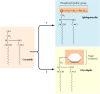
Figure ix.26
Synthesis of sphingomyelin and glycolipids. Ceramide, which is synthesized in the ER, is converted either to sphingomyelin (a phospholipid) or to glycolipids in the Golgi apparatus. In the first reaction, a phosphorylcholine group is transferred from (more...)
Sphingomyelin is synthesized on the lumenal surface of the Golgi, only glucose is added to ceramide on the cytosolic side. Glucosylceramide then patently flips, even so, and additional carbohydrates are added on the lumenal side of the membrane. Neither sphingomyelin nor the glycolipids are then able to translocate beyond the Golgi membrane, and then they are establish only in the lumenal half of the Golgi bilayer. Post-obit vesicular transport, they are correspondingly localized to the exterior half of the plasma membrane, with their polar caput groups exposed on the prison cell surface. As will be discussed in Chapter 12, the oligosaccharide portions of glycolipids are of import surface markers in cell-cell recognition.
In constitute cells, the Golgi apparatus has the additional task of serving as the site where complex polysaccharides of the cell wall are synthesized. As discussed farther in Chapter 12, the establish cell wall is equanimous of three major types of polysaccharides. Cellulose, the predominant elective, is a elementary linear polymer of glucose residues. It is synthesized at the jail cell surface by enzymes in the plasma membrane. The other jail cell wall polysaccharides (hemicelluloses and pectins), all the same, are complex, branched chain molecules that are synthesized in the Golgi appliance and then transported in vesicles to the jail cell surface. The synthesis of these cell wall polysaccharides is a major cellular role, and as much every bit 80% of the metabolic action of the Golgi apparatus in plant cells may exist devoted to polysaccharide synthesis.
Protein Sorting and Export from the Golgi Apparatus
Proteins, as well as lipids and polysaccharides, are transported from the Golgi apparatus to their final destinations through the secretory pathway. This involves the sorting of proteins into different kinds of send vesicles, which bud from the trans Golgi network and deliver their contents to the advisable cellular locations (Figure 9.27). Some proteins are carried from the Golgi to the plasma membrane past a constitutive secretory pathway, which accounts for the incorporation of new proteins and lipids into the plasma membrane, also as for the continuous secretion of proteins from the cell. Other proteins are transported to the cell surface past a distinct pathway of regulated secretion or are specifically targeted to other intracellular destinations, such as lysosomes in animal cells or vacuoles in yeast.

Figure 9.27
Transport from the Golgi appliance. Proteins are sorted in the trans Golgi network and transported in vesicles to their last destinations. In the absence of specific targeting signals, proteins are carried to the plasma membrane by constitutive secretion. (more...)
Proteins that office within the Golgi apparatus must be retained within that organelle, rather than beingness transported along the secretory pathway. In dissimilarity to the ER, all of the proteins retained within the Golgi circuitous are associated with the Golgi membrane rather than being soluble proteins within the lumen. The signals responsible for retentiveness of some proteins inside the Golgi have been localized to their transmembrane domains, which retain proteins inside the Golgi apparatus by preventing them from being packaged in the send vesicles that exit the trans Golgi network. In add-on, like the KKXX sequences of resident ER membrane proteins, signals in the cytoplasmic tails of some Golgi proteins mediate the retrieval of these proteins from subsequent compartments forth the secretory pathway.
The constitutive secretory pathway, which operates in all cells, leads to continual unregulated protein secretion. Even so, some cells besides possess a singled-out regulated secretory pathway in which specific proteins are secreted in response to ecology signals. Examples of regulated secretion include the release of hormones from endocrine cells, the release of neurotransmitters from neurons, and the release of digestive enzymes from the pancreatic acinar cells discussed at the beginning of this affiliate (see Figure 9.ii). Proteins are sorted into the regulated secretory pathway in the trans Golgi network, where they are packaged into specialized secretory vesicles. These secretory vesicles, which are larger than other transport vesicles, store their contents until specific signals direct their fusion with the plasma membrane. For example, the digestive enzymes produced by pancreatic acinar cells are stored in secretory vesicles until the presence of food in the stomach and small intestine triggers their secretion. The sorting of proteins into the regulated secretory pathway appears to involve the recognition of bespeak patches shared by multiple proteins that enter this pathway. These proteins selectively aggregate in the trans Golgi network and are then released by budding as secretory vesicles.
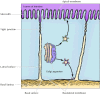
A further complication in the transport of proteins to the plasma membrane arises in many epithelial cells, which are polarized when they are organized into tissues. The plasma membrane of such cells is divided into two divide regions, the apical domain and the basolateral domain, that incorporate specific proteins related to their detail functions. For case, the upmost membrane of intestinal epithelial cells faces the lumen of the intestine and is specialized for the efficient absorption of nutrients; the residue of the cell is covered by the basolateral membrane (Effigy 9.28). Distinct domains of the plasma membrane are present non just in epithelial cells, but also in other cell types. Thus, the constitutive secretory pathway must selectively transport proteins from the trans Golgi network to these distinct domains of the plasma membrane. This is achieved by the selective packaging of proteins into at least two types of constitutive secretory vesicles that leave the trans Golgi network targeted specifically for either the apical or basolateral plasma membrane domains of the cell.
Effigy 9.28
Transport to the plasma membrane of polarized cells. The plasma membranes of polarized epithelial cells are divided into upmost and basolateral domains. In this case (intestinal epithelium), the upmost surface of the prison cell faces the lumen of the intestine, (more...)
The all-time-characterized pathway of poly peptide sorting in the Golgi is the selective send of proteins to lysosomes. As already discussed, lumenal lysosomal proteins are marked by mannose-6-phosphates that are formed by modification of their N-linked oligosaccharides before long after entry into the Golgi apparatus. A specific receptor in the membrane of the trans Golgi network and so recognizes these mannose-6-phosphate residues. The resulting complexes of receptor plus lysosomal enzyme are packaged into transport vesicles destined for lysosomes. Lysosomal membrane proteins are targeted past sequences in their cytoplasmic tails, rather than by mannose-6-phosphates.
In yeasts and plant cells, which lack lysosomes, proteins are transported from the Golgi apparatus to an boosted destination: the vacuole (Figure 9.29). Vacuoles assume the functions of lysosomes in these cells too equally performing a diversity of other tasks, such equally the storage of nutrients and the maintenance of turgor force per unit area and osmotic residue. In contrast to lysosomal targeting, proteins are directed to vacuoles by short peptide sequences instead of saccharide markers.
Figure 9.29
A plant cell vacuole. The large fundamental vacuole functions as a lysosome in improver to storing nutrients and maintaining osmotic balance. (Eastward. H. Newcombe/Biological Photo Service.)
Source: https://www.ncbi.nlm.nih.gov/books/NBK9838/
Posted by: griffithboakist.blogspot.com
0 Response to "What Is The Main Function Of The Golgi In An Animal Cell"
Post a Comment